
An Open Letter to Zimbabwean Youth and Aspiring Entrepreneurs
Skills Series – Part 3 (Hatitaure ngano muno, ngatishandei hama, rather than just complaining that there are no jobs!)
Dear Unemployed Graduate,
Of course you have a degree. Accounting. Social work. Marketing. Veterinary science. Sociology. Business management. Statistics. Development studies. You worked hard for it. You earned it. But here you are, 3 years after graduating, still unemployed. Still sending applications. Still waiting.
So we ask you this: why not have an open mind?
Put that degree aside for a moment. Not forever, just for now. Acquire a skill that will put money in your pocket whether you are employed or not. A skill that does not depend on someone hiring you. A skill that feeds you through your own hands and your own effort.

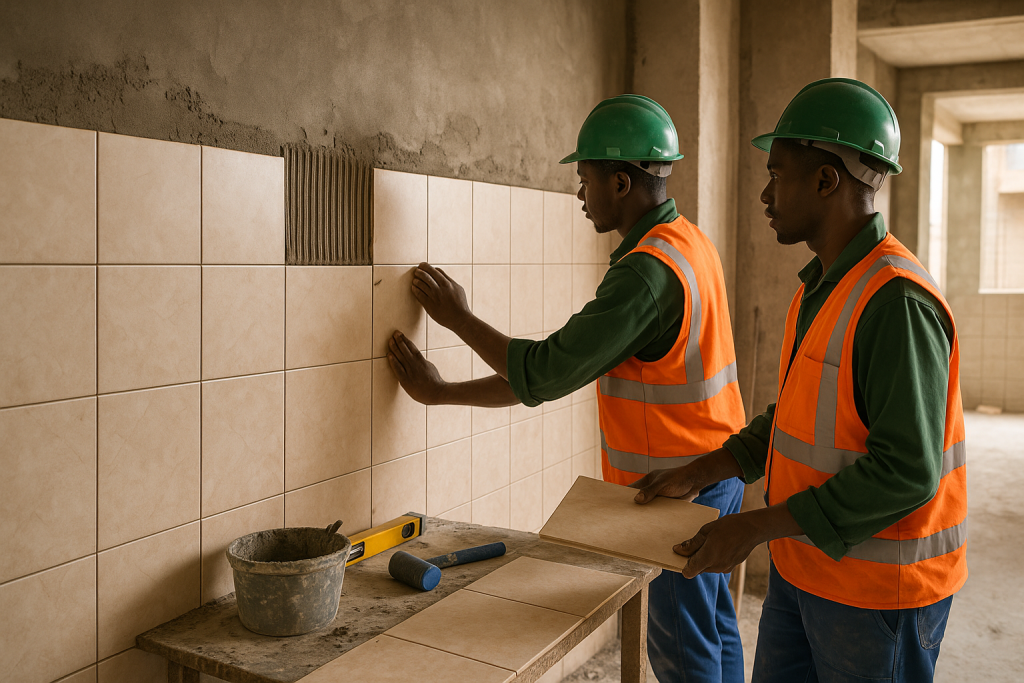
Many people look down upon the construction industry. They see it as beneath them. They believe a degree holder should not be laying tiles or mixing adhesive. But here is the truth: the construction industry is one of the most profitable industries in Zimbabwe right now. It is booming. It is full of opportunities. People with no degrees are earning far more than many degree holders sitting at home waiting for that email that never comes.
Think outside the box. Your degree gave you knowledge. A skill will give you income.
This is the third article in our skills series designed to help Zimbabweans survive, adapt, and eventually thrive in an economy where jobs are scarce and informality is the reality. In Part 1, we covered Graphic Design. In Part 2, we covered CCTV Installation. Today, we move into one of the most in-demand practical skills in Zimbabwe’s booming construction industry: Floor and Wall Tiling.

Tiling is not for everyone, and that is perfectly fine. This series will cover many different skills over time, both digital and practical, and you will definitely find something that suits your strengths. The goal is not to force you into one path, but to expose you to real, usable skills that can change your direction in life if you take them seriously.
What matters most is this: the first step is acquiring a skill. Everything else comes after.
Why Tiling Is a Powerful Skill in Zimbabwe
Zimbabwe is experiencing a construction boom. People are building homes, renovating existing houses, constructing commercial properties, and upgrading offices, shops, and churches. Every single one of these projects needs tiling. Floors need tiling. Bathrooms need tiling. Kitchens need tiling. Verandas need tiling. Shops need tiling. Office reception areas need tiling.

The demand for skilled tilers far exceeds the supply. Many homeowners struggle to find reliable, skilled tilers who show up on time, do quality work, and finish the job professionally. This gap between demand and supply is your opportunity.
Tiling is also one of the most accessible construction skills to learn. You do not need heavy machinery. You do not need an engineering degree. You need a tile cutter, a few basic tools, knowledge of the craft, and the willingness to do physical work with precision and attention to detail.
What Tilers Actually Do
Many people think tiling is simply sticking tiles onto a surface. The reality involves much more skill and knowledge. A professional tiler handles:

Surface assessment and preparation, measuring and calculating tile quantities, planning tile layouts for even cuts and balanced patterns, mixing and applying tile adhesive correctly, cutting tiles using manual and electric tile cutters, setting tiles on floors and walls with consistent spacing, installing tile spacers and levelling systems, applying grout between tiles and cleaning excess grout, installing aluminium edge trims and corner profiles, waterproofing bathrooms and wet areas before tiling, working with different tile types (ceramic, porcelain, mosaic, natural stone), creating decorative patterns and feature walls, and repairing or replacing damaged tiles.
Types of Tiling Work in Zimbabwe
As a tiler, you will encounter various types of projects:
Residential floor tiling is the most common. This includes living rooms, bedrooms, kitchens, corridors, and verandas. Standard floor tiles in Zimbabwe range from 30x30cm to 60x60cm, with 40x40cm and 60x60cm being the most popular.

Bathroom and kitchen wall tiling requires additional skills, especially waterproofing. Bathrooms need careful attention to water resistance, and clients often want unique designs and patterns that command higher prices.
Commercial tiling covers shops, offices, restaurants, hotels, and public buildings. These projects are larger and more profitable but require speed and the ability to work to deadlines.
Outdoor tiling includes verandas, patios, driveways, and swimming pool surrounds. Outdoor tiling requires specific tiles rated for exterior use and knowledge of expansion joints.

Specialised tiling involves mosaic tiles, natural stone, large format tiles, and decorative feature walls. These require advanced skills and command premium rates.
Materials You Will Work With
A tiler needs to understand various materials:
Ceramic tiles (the most common and affordable), porcelain tiles (harder and more durable), mosaic tiles (small decorative tiles for feature areas), natural stone tiles (granite, marble, slate), tile adhesive (cement-based and ready-mixed), tile grout (sanded and unsanded, various colours), aluminium edge trims and corner profiles, bonding liquid, waterproofing membrane, tile spacers (2mm for walls, 3mm for floors), and self-levelling compound for uneven floors.

How to Learn Tiling in Zimbabwe
You can learn tiling both online and offline, through free and paid options, and also on the job by working with experienced tilers.
Free online courses are excellent for understanding theory, techniques, and best practices. Paid courses with practical components give you structured hands-on experience. But one of the most effective ways to learn tiling is by working alongside experienced tilers on actual job sites.
Learning on the Job
If you cannot afford to start with paid courses, there is another powerful way to learn: offer to work for free as an assistant to an experienced tiler. Many tilers need assistants to mix adhesive, carry tiles, clean up, and do basic preparation work. By working alongside them, you observe their techniques, learn how the industry operates, understand client expectations, and gain real-world experience.

Even if you are paid minimal wages or nothing at all, what you are gaining is far more valuable: practical experience and industry knowledge. You learn how to handle different tile sizes, how to cut around obstacles, how to deal with uneven surfaces, and how to manage your time on a job. This hands-on learning is something no online course can fully replace.
Once you feel confident in your skills, you can start taking on your own small jobs and building your reputation.
Free Online Tiling Courses
* https://www.elevify.com/en-us/courses/engineering-construction-and-technology/construction/wall-floor-tiler-setter-course-28409 (Elevify – Wall and Floor Tiler Course – free, self-paced course with videos, audio, and text covering layout planning, wall and floor tile installation, levelling and bedding techniques, wet-area substrate preparation, waterproofing, grouting, sealing, and a certificate upon completion)

* https://www.ceramictilefoundation.org/become-certified-tile-installer-training-videos (CTEF Certified Tile Installer Prep Course – free 8-video course covering job site safety, backer board types, wall tile installation, floor tile installation, grouting practices, sealant joints, and time management)
* https://www.laticrete.com/support-and-training/training-hub/laticrete-university (LATICRETE University – free tutorials covering tile types, installation methods, adhesive selection, membrane usage, grout basics, surface preparation, self-levelling underlayments, with certificates of completion)
* https://cursa.app/en/free-course/how-to-tile-cidd (Cursa – How to Tile Course – free course covering fundamental tiling principles, bathroom shower tiling, cutting, fitting, grouting, and common problem-solving scenarios with a free digital certificate)

* https://alison.com/course/become-a-painter-and-decorator (Alison – Become a Painter and Decorator – free course that includes a dedicated tiling module covering tools required, choosing the correct tile type, and ideal tiling and grouting procedures)
* https://www.youtube.com/results?search_query=floor+and+wall+tiling+course (YouTube has numerous free video tutorials on tiling from various instructors covering every aspect of the craft)
Paid Tiling Courses in Zimbabwe
Ixar Academy
Wall & Floor Tiling Course
$20 Registration Fee
$100 Full Course
Duration: 1 Month
Contact: +263786329089
1st Floor, Batanai Gardens, Corner 1st & Jason Moyo, Harare
St. Peter’s Kubatana Industrial Training College
Tiling Course
Fee: $120 per month
Duration: 1 Month
Contact: +263 864 428 3755 | +263 864 428 3756 | +263 864 428 3757
Corner Main / Highglen Road, P.O. Box HD 35, Highfield, Harare
Msasa Industrial Training College
Tiling Course
Fee: $125
Duration: 6 Saturdays
Contact: +263 0242 486494 | msasaitc@gmail.com
22 Felice Avenue, Msasa, Harare, Zimbabwe
Carlkum Painting & Tiling School
Tiling Course
Fee: $60
Duration: 2 Weeks
Contact: +263 786 702 781 | +263 773 880 634
Stand No. 18267, Unit L, Chitungwiza
Tiling Is Not About Getting a Job
This is very important. The primary goal of learning tiling in Zimbabwe is not employment. Jobs are scarce. If you happen to get employment with a construction company, that is a bonus, especially when you are just starting and need experience. However, that is not the end goal.
The main goal is to become an independent tiling contractor.
Tiling allows you to sell skill, not time. You charge per square metre. You set your own rates. You choose your own projects. That is power.
How Tiling Work Operates in Zimbabwe
The typical arrangement in Zimbabwe is straightforward. The homeowner or property owner purchases all the materials using their own funds. This includes tiles, tile adhesive, tile grout, aluminium edge trims, bonding liquid, tile spacers, and any other consumables. You, as the tiler, bring your own equipment such as your tile cutter, trowels, spirit level, mixing bucket, and other tools. You then carry out the installation and charge for your labour.
This means you do not need capital to buy materials. Your main investment is in your tools and your skill. The client provides everything else.
Pricing Your Services
In Zimbabwe, tilers charge per square metre. The standard labour rate is US$3 to US$4 per square metre for standard floor and wall tiling.
Unique and complex designs command higher rates. Bathroom tiling with intricate patterns, feature walls, mosaic tile installations, and work with specialised tiles like natural stone or large format porcelain can fetch significantly more. For these types of jobs, you can charge US$5 to US$10 or more per square metre depending on the complexity.
What This Means in Real Earnings
To put this into perspective, consider a typical residential floor tiling job:
A 200 square metre floor area at US$3 to US$4 per square metre earns you US$600 to US$800. With a team of 3 people, a job of this size can be finished in a few days, certainly less than a week. That is a substantial amount of money for less than a week of work.
Smaller jobs are common too. A single room of 15 to 20 square metres earns you US$45 to US$80, which you can complete in a day. A bathroom of 10 to 15 square metres earns you US$30 to US$60 for the floor, plus additional income for wall tiling.
The key is consistency. If you are doing several jobs per month, you can earn a very comfortable living.
How to Start
You can start from home. You do not need an office or a shop. Market your services on WhatsApp, Facebook, and door-to-door. Be proactive, but professional.
Start with small jobs. A single room floor installation is perfectly fine as your first job. Do not wait for a big project before you begin. Every job is an opportunity to practise, improve, and build your reputation.
Build your portfolio from day one. Take photos and videos of every job you do. Capture the before and after. Show the bare concrete floor and then the beautifully tiled finish. These images become your most powerful marketing tool.
Essential Tools to Start
You do not need to buy everything at once. Start with the basics:
Manual tile cutter (for straight cuts), angle grinder with diamond blade (for complex cuts), notched trowel (for applying adhesive), rubber grout float, spirit level, measuring tape, mixing bucket, sponge for cleaning, tile spacers, pencil and straight edge, and knee pads for comfort.
Initial investment estimate: US$50 to US$200 for basic tools.
As your business grows, you can invest in an electric tile cutter (wet saw), laser level, and other professional equipment.
Marketing Your Tiling Services
Marketing is not optional. It is as important as the skill itself. Many talented tilers fail simply because nobody knows they exist.
The construction industry in Zimbabwe runs heavily on referrals. When people need a tiler, they do not search the internet. They ask for recommendations from other homeowners, on community groups, and on WhatsApp and Facebook groups. Your reputation is your biggest asset.
Join home builders Facebook groups. Groups like Let’s Build Our Homes ZW are extremely popular and active. Homeowners regularly post asking for tiler recommendations. When someone asks, respond with your work samples and contact details. Be helpful and professional in these groups. Share tips and advice. People notice and remember those who add value.
Build relationships with other construction contractors. Builders, bricklayers, and plastering contractors are some of your best sources of referrals. After a builder finishes constructing a house, the next step is tiling. The homeowner will often ask the builder to recommend a tiler. If you have a good relationship with builders, they will send clients your way consistently. This single strategy alone can keep you busy throughout the year.
Post your work consistently on WhatsApp and Facebook. Share your before-and-after photos. Show the transformation. Let people see what you are capable of. Do not wait for clients to come to you.
Word of mouth is powerful. Deliver quality work on time. Be professional. Show up when you say you will. Clients who trust you will recommend you to others without you even asking.
Working With Assistants
Tiling is physical work, and on larger jobs you will need help. Tilers work with assistants who handle tasks like mixing adhesive, carrying tiles to the work area, cleaning surfaces, and general preparation.
When you are just starting, you can work with yourself and 1 part-time assistant. You do not need to hire anyone full-time. Pay your assistant per job or per day.
As your jobs get bigger, you can bring in other skilled tilers to help you complete the work faster. There are many people in Zimbabwe who are good at tiling but are not good at marketing themselves or finding clients. These individuals do not need to become your business partners. They simply become part-time workers you call when there is a job. You agree on a fee, they help you complete the work, and you pay them once the job is done.
This approach allows you to take on larger projects without turning down work. You earn a margin on their labour while delivering a quality finished product to the client.
Growing the Business Over Time
As your reputation grows and referrals increase, you will reach a point where you have more work than you can handle alone. This is where real growth begins.
You may start by taking on an apprentice who learns from you while assisting on jobs. You may build a team of 2 to 3 skilled tilers who work under your name. You may invest in better tools and a vehicle for transporting equipment.
With time, you may expand beyond just tiling. Many successful tiling contractors add related services like screeding (floor levelling), waterproofing, painting, and general finishing work. Some go on to become full construction finishing contractors handling tiling, painting, ceiling installation, and interior finishing as a complete package.
What started as one person with a tile cutter can grow into a full company employing several people and handling multiple projects simultaneously. With time and years of consistent work, you can end up having your own big tiling company doing big commercial and residential jobs.
Final Encouragement
Tiling will not make you rich overnight. It requires learning, practice, patience, physical effort, and attention to detail. But with a skill in your hands, you are no longer helpless. You are no longer waiting for someone to give you a job.
Zimbabwe’s construction industry is growing. Every new house, every renovation, every commercial project needs tiling. The demand is there. The question is whether you will position yourself to meet it.
This is only the third skill in our series. In the coming weeks, we will explore more skills, one by one. Somewhere in this series is a skill that will unlock your future.
Take the first step.
With belief in your ability to build something meaningful,
ZimLedger Admin

ZimLedger
ZimLedger is the all in one business and finance platform for Zimbabwe. It generates quotes, invoices, payslips and financial statements, manages business ledgers, tracks income and expenses, and builds shopping lists. ZimLedger offers a simple yet powerful solution tailored to local needs. Whether you are budgeting in ZiG or USD, managing business accounts, converting Ecocash statements, or tracking household expenses, ZimLedger empowers you to stay organised, make informed financial decisions, and grow your wealth—right from your phone or computer.