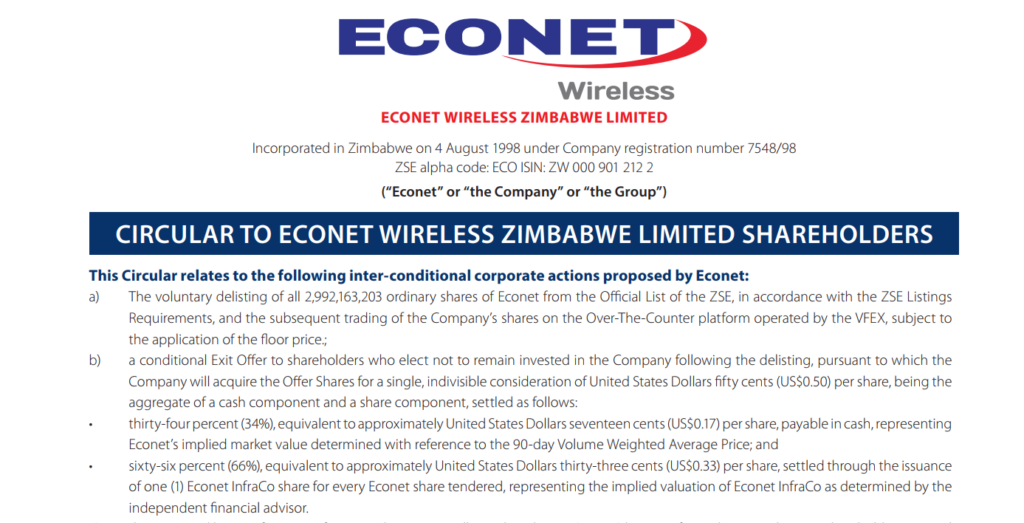
On 4 February 2026, Econet Wireless Zimbabwe Limited published a 99-page circular that could reshape the future of one of Zimbabwe’s most important companies — and the investments of thousands of minority shareholders.
The proposal: voluntarily delist from the Zimbabwe Stock Exchange, spin off a new infrastructure company called Econet InfraCo onto the Victoria Falls Stock Exchange, and offer shareholders US$0.50 per share to walk away.
On the surface, it looks generous. A 192% premium to the 90-day volume-weighted average price of US$0.17. A chance to cash out at levels not seen on the ZSE in years.
But beneath the headline number lies a transaction of extraordinary complexity — one where the structure matters as much as the price, where the valuation of a newly created company determines two-thirds of your payout, and where the default option of doing nothing could lock you into an unlisted company with limited rights and constrained liquidity for years.
This newsletter breaks down everything you need to know to make an informed decision. We are going to examine what you actually receive if you accept the Exit Offer, what happens if you remain invested, how the numbers really stack up, and what the controlling shareholder stands to gain from this restructuring.

The deadlines are tight. The EGM is on 26 February 2026. The Exit Offer window closes on 9 March 2026. Doing nothing is itself a decision — and it may not be the one you intended to make.
The Transaction at a Glance
Econet Wireless Zimbabwe Limited (ZSE: ECO) proposes to:
- Voluntarily delist from the Zimbabwe Stock Exchange
- List Econet InfraCo — a newly created subsidiary holding towers, real estate, and power assets — on the Victoria Falls Stock Exchange (VFEX)
- Offer shareholders US$0.50 per share as an Exit Offer, consisting of US$0.17 in cash and 1 Econet InfraCo share valued at US$0.33
The controlling shareholder, Econet Global Limited (held by the Masiyiwa family), owns 41.68% of Econet and will not participate in the Exit Offer. It intends to remain invested in the unlisted company.

Your Two Options — And What Each Actually Means
Option 1: Accept the Exit Offer
You surrender your Econet shares and receive, per share:
| Component | Amount | Nature |
|---|---|---|
| Cash | US$0.17 | Guaranteed, immediate |
| 1 Econet InfraCo share | US$0.33 (implied) | Listed on VFEX, market value uncertain |
| Total | US$0.50 | Only 34% is guaranteed cash |
The critical point: Only US$0.17 — one-third of the offer — is guaranteed cash in your hand. The remaining US$0.33 depends entirely on how the market values Econet InfraCo once it begins trading on the VFEX on 31 March 2026.
If InfraCo trades at the implied US$0.33, you get the full US$0.50. If the market prices it at US$0.15 (which is plausible, as we will explain below), your actual payout drops to US$0.32.

Your election is irrevocable. Once you submit your acceptance, you cannot change your mind.
Option 2: Remain Invested (The Default If You Do Nothing)
If you do not submit a valid Exit Offer election form by 9 March 2026, you automatically remain a shareholder in Econet — which will now be an unlisted public company.
What this means in practice:

- Your shares are no longer tradeable on the ZSE
- Trading moves to a VFEX-operated OTC platform with significant restrictions
- The Board must approve all transfers to new shareholders and can reject them for any reason — silence within 7 days means rejection
- A 12-month buyback moratorium applies from 31 March 2026 to March 2027 — no share repurchases during this period
- After the moratorium, Econet may repurchase up to 10% of outstanding shares per year at a floor price of US$0.50 — but this is at the Board’s discretion, not a guaranteed right
- You retain your proportional economic interest in Econet’s full operating business including mobile services, EcoCash, and digital platforms
- You also retain indirect ownership of Econet’s 70% stake in the listed InfraCo
The default option is not neutral. If you intend to accept the Exit Offer, you must actively submit your election. If you miss the deadline, you are locked in.
The US$1 Billion Question: Is Econet InfraCo Really Worth That Much?
Because 66% of the Exit Offer is paid in InfraCo shares, the entire offer hinges on whether InfraCo is genuinely worth US$1 billion. This is arguably the most important question in the entire circular.
What InfraCo Actually Is
Econet InfraCo is a newly constituted subsidiary that holds three categories of assets transferred from the Econet group:

- TowerCo: Passive telecommunications infrastructure — ground towers, rooftop sites, in-building solutions
- PowerCo: Distributed power systems — solar installations, diesel generators, battery storage, grid interfaces
- PropCo: Real estate — land, buildings, and operational premises
The business model is simple: InfraCo leases these assets back to Econet under a 10-year master lease agreement. Econet is both the controlling shareholder (through its 70% stake) and essentially the only customer.
The Circular’s Valuation: US$1.0 Billion
The circular arrives at the US$1 billion figure through two methods:
Method 1 — Comparable Company Multiples: The circular benchmarks InfraCo against Zimbabwean listed property companies and derives a weighted average EV/EBITDA multiple of approximately 20x. Applied to InfraCo’s forecast EBITDA of US$50.42 million, this produces an enterprise value of approximately US$1.008 billion.

Method 2 — Discounted Cash Flow: The independent financial advisor uses a WACC of 11.79% and an exit multiple of 18x, arriving at an enterprise value of US$1.078 billion.
Both methods support the US$1 billion headline. But both rely on assumptions that deserve serious scrutiny.
Why the Valuation May Be Significantly Inflated
Problem 1: InfraCo is a tower company being valued as a property company. The circular compares InfraCo to small Zimbabwean property companies — First Mutual Properties, Mashonaland Holdings, Tigere, and Revitus — with a combined enterprise value of only US$195.9 million. These are conventional property businesses (offices, retail centres, residential developments), not tower infrastructure companies. The circular’s own description of InfraCo states that tower operations will be the “primary contributor” to returns. If InfraCo is fundamentally a tower company, it should be valued like a tower company.

Problem 2: The book value gap is enormous. InfraCo’s own pro forma balance sheet shows total assets of US$185.12 million, including property, plant and equipment of US$151.38 million and cash of US$45.24 million. The circular is asking the market to accept a US$1 billion valuation for a company whose entire asset base is worth US$185 million on paper. That is a 5.4x premium to book value — a level of franchise premium that would need to be justified by extraordinary growth prospects, diversified revenue streams, or irreplaceable competitive advantages. InfraCo has none of these. It has forecast EBITDA from a single customer under a single lease agreement.
Problem 3: Listed African tower companies — the businesses that actually do what InfraCo does — trade at a fraction of this multiple. The circular benchmarks InfraCo against Zimbabwean property companies to arrive at a 20x EV/EBITDA multiple. But by the circular’s own admission, InfraCo is primarily a tower and infrastructure business. Listed African tower operators trade in the range of 5x to 10x EV/EBITDA, depending on the company and market conditions. Even at the generous end of that range, InfraCo’s enterprise value would be approximately US$500 million — half the circular’s figure. At the conservative end, it falls closer to US$250 million, implying a per-share value of roughly US$0.08 to US$0.17 rather than US$0.33. The choice of peer group is not a technicality — it is the single biggest driver of whether this is a US$1 billion company or a US$400 million company.
Problem 4: InfraCo has one customer in one country — yet it is being valued as if it had the diversification of a multi-market operator. The tower companies that command premium multiples globally earn those premiums by leasing infrastructure to multiple mobile network operators across multiple countries. They have tenant diversification, geographic spread, and contractual protections against single-counterparty risk. InfraCo has Econet, and only Econet, under a 10-year lease in Zimbabwe. Beyond the concentration risk, this is also a structural conflict of interest — Econet is simultaneously InfraCo’s 70% controlling shareholder and its only material revenue source. When the lease comes up for renewal, Econet will effectively be negotiating with itself. Minority shareholders in InfraCo have no ability to influence those terms.

Problem 5: The discount rate used to value InfraCo is lower than what most Zimbabwean businesses would use for their own internal investment decisions. The independent advisor’s DCF uses a WACC of 11.79%. To put this in perspective, Professor Aswath Damodaran of NYU Stern — widely regarded as the global authority on corporate valuation — publishes country risk premiums for every market in the world. His data assigns Zimbabwe a country risk premium of 11.66% and an equity risk premium of 15.89%. The advisor’s entire WACC of 11.79% is barely above Zimbabwe’s country risk premium alone — before even accounting for the cost of debt, the specific risks of this business, or any company-level premium. Any Zimbabwean business owner evaluating whether to invest in a new project — whether a new shop, a fleet of trucks, or a piece of equipment — would typically demand a return well above 20% to justify tying up capital in this economy. Interest rates on commercial lending in Zimbabwe routinely exceed 15% to 20%. Yet the advisor is telling us that investors should be satisfied with an 11.79% return from a newly created company with zero independent track record and a single customer. If the WACC were adjusted to a more realistic 16% to 20%, the DCF valuation would shrink to roughly half the US$1 billion headline figure.
Problem 6: Every number in InfraCo’s financials is a projection. InfraCo has never filed a tax return. It has never collected revenue from a customer. It has never paid a supplier, met a payroll, or navigated a dispute with a tenant — because it has only ever existed as an internal corporate restructuring exercise. The US$50.42 million EBITDA is a management forecast prepared specifically for this circular. It has not been tested by an independent audit, stress-tested against economic downturns, or validated by actual market performance. The entire US$1 billion valuation rests on the assumption that these projections will materialise exactly as presented.
Problem 7: At this valuation, InfraCo would instantly rank among the most expensive companies on any Zimbabwean exchange — despite having zero proven performance. Delta Corporation generates approximately 8 times more revenue and 6 times more profit than InfraCo is forecasting, yet its market capitalisation is comparable. Simbisa Brands operates hundreds of restaurants across multiple African countries with years of audited results and trades well below the implied InfraCo valuation. Even InfraCo’s implied price-to-earnings ratio of over 37x would place it above most blue-chip companies globally — not just in Zimbabwe. The market is being asked to price a company that has never independently operated alongside businesses with decades of track record and billions in cumulative revenue.

Our Independent Valuation Estimate
Using multiple methodologies — African tower comparables, adjusted DCF with a more realistic WACC, asset-based valuation, and earnings yield analysis — we estimate InfraCo’s fair enterprise value at approximately US$350 million to US$500 million, with a central estimate of approximately US$425 million.
This translates to approximately US$0.12 to US$0.17 per InfraCo share, with a midpoint of US$0.14.
What This Means for Your Exit Offer
| Scenario | Cash | InfraCo Share Value | Total Per Share |
|---|---|---|---|
| Circular’s valuation | US$0.17 | US$0.33 | US$0.50 |
| Our central estimate | US$0.17 | US$0.14 | US$0.31 |
| If market applies African tower multiples | US$0.17 | US$0.13 | US$0.30 |
| If market applies severe discount | US$0.17 | US$0.08 | US$0.25 |
The headline US$0.50 may in reality be closer to US$0.31 once the market determines InfraCo’s actual trading price. That is still a meaningful premium to the pre-announcement 90-day VWAP of US$0.17 — but far less generous than advertised.

The Operating Business They Are Taking Private
While much attention focuses on InfraCo, the truly valuable asset in this transaction is the operating telecommunications business that will become an unlisted company after the delisting.
The Raw Numbers
| Metric | Econet Operating Business (ex-InfraCo) | Econet InfraCo |
|---|---|---|
| Annual EBITDA | approximately US$309 million | US$50.42 million (forecast) |
| Revenue | approximately US$713 million | US$122.75 million (forecast) |
| Subscribers | 16.8 million | Zero direct customers |
| Customer base | Millions of retail and enterprise users | Single anchor tenant |
| Operating history | 27 years since 1998 | Zero as independent entity |
| Key assets | Spectrum, network, EcoCash, brand, distribution | Towers, buildings, solar panels |
The operating business generates 6.1 times the EBITDA of InfraCo. It holds irreplaceable spectrum licences. It operates EcoCash — Zimbabwe’s dominant mobile money platform that is effectively critical national financial infrastructure. It has a brand, distribution network, and customer relationships built over nearly three decades.
The Valuation Inversion
Here is the uncomfortable arithmetic at the heart of this transaction:
| Component | Circular’s Implied Value | Reasonable Estimate |
|---|---|---|
| Econet operating business | US$507 million (based on 90-day VWAP) | US$1.07 to US$1.69 billion |
| Econet InfraCo | US$1.0 billion | US$350 to US$500 million |
The circular assigns nearly double the value to InfraCo compared to the operating business. The tail is being priced higher than the dog.
This happens because the cash component of the Exit Offer (US$0.17) is pegged to the 90-day VWAP — the very market price the Board acknowledges is dysfunctional and does not reflect intrinsic value. The Board spends pages arguing the ZSE price is broken, then uses that broken price to compensate minorities for the operating business.
Meanwhile, InfraCo — with no independent operating history and a single customer — is assigned a premium valuation using optimistic forecasts and an aggressive peer multiple.
What Happens If Not Enough Shareholders Accept the Exit Offer
The VFEX requires Econet InfraCo to have at least 30% of its shares held by the public for the listing to proceed. Since InfraCo has 2,992,163,203 shares, at least 897,648,961 must be in public hands.
The Maths Are Daunting
For 30% to be achieved purely through the Exit Offer, shareholders holding approximately 897 million Econet shares must tender. The eligible pool (excluding Econet Global at 41.68%) is approximately 1,745 million shares.
This means 51.4% of all eligible minority shareholders must accept the Exit Offer within a 10-day window. Given nominee account friction, retail shareholder inertia, the compressed timeline, and mixed institutional incentives, this level of take-up is highly unlikely.
The Dividend in Specie: A Safety Net
If the 30% threshold is not met, the circular provides a backup mechanism: Econet will distribute additional InfraCo shares to all Econet shareholders as a dividend in specie, on a pro rata basis, until the 30% public float is achieved.
This is arguably the most important provision for shareholders considering whether to remain invested. If take-up is low (which we believe is the most likely scenario), remaining shareholders receive free listed InfraCo shares without having surrendered any Econet shares. The dividend in specie goes to all Econet shareholders pro rata — including Econet Global Limited at 41.68%.
A 10% withholding tax also applies to the dividend in specie.
What This Means for You
If you remain invested and the dividend in specie is triggered, you end up holding:
- Your original Econet shares (unlisted, OTC-tradeable with restrictions)
- Plus directly held Econet InfraCo shares (listed on VFEX, freely tradeable)
This mixed portfolio is a meaningfully better outcome than holding purely unlisted shares with no listed component.
The Controlling Shareholder’s Position
Who Benefits Most
Econet Global Limited holds 41.68% of Econet. It is not participating in the Exit Offer. After the delisting, it retains its full stake in an unlisted company whose operating business is worth — by any reasonable peer-based methodology — well over US$1 billion.
The controlling shareholder gains:
- Complete operational freedom without ZSE continuous disclosure obligations
- Ability to allocate capital without minority shareholder approval for most decisions
- Control over information flow to remaining minority shareholders
- Elimination of the theoretical risk of activist shareholders or hostile approaches
- A credible US$1.5 billion valuation reference established through the US$0.50 buyback floor price (2,992,163,203 shares × US$0.50 = US$1.496 billion)
- Increased proportional ownership as minorities exit through the Exit Offer
The implied EV/EBITDA at the US$0.50 floor price is approximately 3.75x — well below the peer average of 5x to 6x for African telecoms — meaning there is significant embedded upside potential that accrues primarily to the party with the largest stake and the most control.
The Cash Preservation Incentive
The Exit Offer’s cash component is US$0.17 per share. If 30% of eligible minorities exit, the total cash outlay is approximately US$153 million. If only 15% exit, it drops to approximately US$76 million. Lower take-up preserves more cash inside the operating company — cash that the controlling shareholder effectively controls.
The transaction structure naturally produces moderate-to-low take-up through several design features:
- The default if you do nothing is to remain invested (not to exit)
- The 10-day election window is deliberately compressed
- 66% of the consideration is in shares of an unproven entity at an aggressive valuation
- The 99-page circular is dense and complex, favouring informed insiders over retail shareholders
The Vote: Your Most Powerful Lever
The delisting requires approval by not less than 75% of the votes cast at the EGM on 26 February 2026. Econet Global Limited, Econet Life, and Econet Insurance are excluded from voting.
This means the delisting is decided entirely by minority and institutional shareholders. It is not a foregone conclusion.
The Blocking Arithmetic
To block the delisting, shareholders representing more than 25% of votes cast must vote against. The outcome depends heavily on voter turnout — the 75% threshold applies to votes actually cast, not total eligible shares.
At 50% turnout, opponents need roughly 200 million shares voting against. This would require coordination among several major institutional holders — difficult but not impossible.
Why You Should Vote Regardless of Your Exit Decision
Even if you intend to accept the Exit Offer, your vote on the delisting resolution is your most powerful piece of leverage. If the delisting fails, the Exit Offer does not proceed, and Econet remains listed on the ZSE. The asset transfers to InfraCo have already occurred, but InfraCo would remain a wholly owned subsidiary.
The proxy form deadline is Tuesday, 24 February 2026 at 10:00 CAT. Pre-registration for the EGM is required no later than 48 hours before the meeting via econetegm.fts-net.com.
Practical Guide: Making Your Decision
Consider Accepting the Exit Offer If:
- You need liquidity and want guaranteed cash in hand
- You are sceptical about the governance protections available to minorities in an unlisted company
- Your investment mandate requires listed securities
- You want to avoid the 12-month buyback moratorium and the uncertainty of OTC trading
- You are comfortable with InfraCo’s VFEX trading risk on the share component
- You purchased your shares at or below US$0.17 and want to lock in a meaningful return
Consider Remaining Invested If:
- You have a long-term investment horizon (5+ years) and high tolerance for illiquidity
- You believe the operating business is deeply undervalued at the implied US$0.17 per share
- You want to maintain full economic exposure to a US$309 million EBITDA business trading at approximately 1.4x EV/EBITDA
- You expect the dividend in specie to be triggered, giving you free listed InfraCo shares
- You trust that the US$0.50 buyback floor will be honoured after the moratorium period
- You believe a future relisting or strategic transaction could unlock the operating business’s intrinsic value
Consider a Split Election If:
The Exit Offer permits partial acceptances. You could tender a portion of your shares to receive some cash and InfraCo shares while retaining the remainder in unlisted Econet. This hedges both outcomes but requires careful calculation of your desired allocation.
Key Dates You Cannot Afford to Miss
| Date | Event |
|---|---|
| Now — 24 February 2026 | Submit proxy forms if you cannot attend the EGM in person |
| 24 February 2026, 10:00 CAT | Proxy form submission deadline |
| 24 February 2026 | Pre-registration deadline for EGM (48 hours before) |
| 26 February 2026, 10:00 CAT | Extraordinary General Meeting — the delisting vote |
| 27 February 2026 | Exit Offer opens |
| 9 March 2026 | Exit Offer closes — elections are irrevocable |
| 31 March 2026 | Settlement of Exit Offer and Econet InfraCo listing on VFEX |
| March 2027 | Earliest date for share repurchases by unlisted Econet |
The Bottom Line
This transaction is not as straightforward as the headline US$0.50 suggests. The real value of the Exit Offer is likely closer to US$0.30 to US$0.32, because two-thirds of the consideration is in InfraCo shares that appear significantly overvalued relative to how comparable African infrastructure companies actually trade.
For the controlling shareholder, the delisting unlocks strategic freedom, eliminates public market scrutiny, and establishes a credible US$1.5 billion valuation for a business that was languishing at US$500 million on the ZSE. These are rational and legitimate objectives.
For minority shareholders, the decision is genuinely difficult. Neither option is perfect. The Exit Offer provides partial liquidity but at a real value below the headline. Remaining invested preserves exposure to a deeply undervalued operating business but at the cost of severe illiquidity and reduced governance protections.
What is clear is that doing nothing is the worst possible strategy. If you are an Econet shareholder, you should:
- Read the circular — it is available at ewzinvestor.com
- Submit your proxy form before 24 February if you cannot attend the EGM
- Vote on the delisting resolution — this is your most powerful lever
- Make an active decision on the Exit Offer before 9 March — do not let the default decide for you
- Consult a professional financial advisor or stockbroker familiar with the Zimbabwean market if you hold a significant position
This is one of the most consequential corporate actions in Zimbabwe’s capital market history. It deserves your full attention.
Disclaimer : This analysis is provided for educational and informational purposes only. It does not constitute financial advice. Individual circumstances, tax positions, portfolio concentrations, and liquidity needs vary. Always consult a qualified financial advisor before making investment decisions.

ZimLedger
ZimLedger is the all in one business and finance platform for Zimbabwe. It generates quotes, invoices, payslips and financial statements, manages business ledgers, tracks income and expenses, and builds shopping lists. ZimLedger offers a simple yet powerful solution tailored to local needs. Whether you are budgeting in ZiG or USD, managing business accounts, converting Ecocash statements, or tracking household expenses, ZimLedger empowers you to stay organised, make informed financial decisions, and grow your wealth—right from your phone or computer.