
An Open Letter to Zimbabwean Youths and Aspiring Entrepreneurs
Skills Series – Part 6 (Maybe one day you will have your own TV Sales & Home or Nash Furnishers)
Dear Reader,
Welcome to Part 6 of the ZimLedger Skills Series. In this series, we share practical skills that Zimbabwean youth and aspiring entrepreneurs can learn to create income and build sustainable businesses. We have covered Graphic Design (Part 1), CCTV Installation (Part 2), Floor and Wall Tiling (Part 3), Car Import Clearing (Part 4), and Computer and Laptop Repair (Part 5). Today, we turn to one of the oldest and most enduring trades — furniture making.
Every home has furniture. Every office has furniture. Every school, every church, every hospital, every hotel, every restaurant — furniture. Beds, wardrobes, tables, chairs, desks, cabinets, shelves, kitchen units, TV stands, shoe racks, benches. The list never ends.
This is why furniture making remains one of the most reliable trades you can learn. The market is not just broad — it is unlimited. As long as people are building houses and renting offices, they will need furniture. As long as people are getting married and setting up homes, they will need furniture. As long as businesses are opening, they will need furniture.

And the furniture industry itself is broad. You can specialise in bedroom furniture, lounge furniture, kitchen furniture, office furniture, outdoor furniture, school furniture, or church furniture. You can focus on solid wood, board and laminate, upholstery, or a combination. Some furniture makers specialise in just one product — like kitchen units or fitted wardrobes — and build entire businesses around that single offering.
Today we are going to show you how to learn this trade, whether you have money for formal training or not.
What Furniture Makers Actually Do
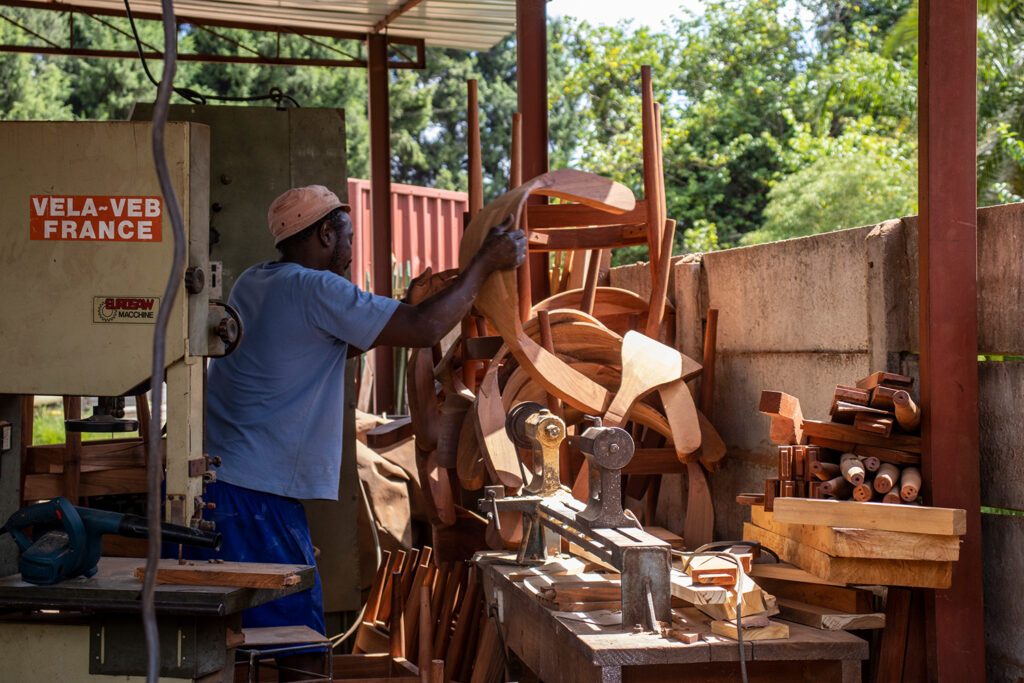
A furniture maker works with wood and wood-based materials to create functional and decorative items for homes, offices, and commercial spaces. The work involves:

Design and Planning — Reading technical drawings, creating cutting lists, calculating material requirements, and planning the construction sequence.
Material Selection — Choosing the right wood species or board materials for each project based on strength, appearance, cost, and intended use.
Cutting and Shaping — Using hand tools and power tools to cut wood to size, create joints, shape edges, and prepare components for assembly.

Joinery — Creating strong connections between pieces using techniques like mortise and tenon, dovetails, dowels, biscuits, pocket screws, or hardware.
Assembly — Putting components together with glue, screws, nails, or other fasteners, ensuring everything is square and properly aligned.
Finishing — Sanding surfaces smooth, applying stains, varnishes, lacquers, or paint to protect the wood and enhance its appearance.

Installation — For fitted furniture like kitchen units and built-in wardrobes, installing the finished product at the customer’s location.
The Best Way to Learn: On the Job
Before we talk about courses and colleges, let us tell you the truth about this trade: the best furniture makers learned by doing.
If you want to learn furniture making quickly and practically, go to High Glen Industrial Area or Glen View Area 8. This is the hub of furniture manufacturing in Zimbabwe. There are hundreds of SMEs in these areas — small workshops producing beds, wardrobes, kitchen units, sofas, and every type of furniture you can imagine.

Here is what you do:
1. Visit the workshops and observe what they are making
2. Identify a workshop that produces the type of furniture you want to learn
3. Approach the owner and offer to work for free as an assistant
4. Learn everything — cutting, joining, assembling, finishing, dealing with customers
5. After a few months, you will know everything you need to start on your own
If you have some funds, you can actually pay them to train you on the job. This is faster because they will prioritise teaching you rather than just using you for labour.

Many of the furniture business owners in Glen View and High Glen started exactly this way — as assistants and employees in someone else’s workshop. They learned the trade, saved some money, bought a few tools, and started their own businesses. Some are now employing dozens of people.
This approach costs little or nothing, you learn real commercial skills, and you build relationships in the industry that can help you later when you need suppliers, customers, or advice.
Free Online Courses
If you want to build theoretical knowledge alongside practical training, or if you cannot access a workshop immediately, these free online courses will teach you the fundamentals.

1. Center for Furniture Craftsmanship — Free Video Library
This is professional-level instruction from one of the most respected furniture schools in the world. The Center for Furniture Craftsmanship in Maine, USA, has made their entire video library free to the public. These are the same videos they use to teach students in their 9-month professional programmes.
What you will learn: Sharpening chisels and plane irons, milling boards “four-square,” hand-cut dovetails (through, half-blind, and sliding), mortise and tenon joinery, machine joinery, wood bending, pattern shaping, hardware installation, and surface preparation.
Why it is valuable: The techniques are gathered from over 100 outstanding woodworkers who have taught at the school over 30 years. This is not beginner hobby content — this is how professional furniture makers work.

URL: https://woodschool.org/videolibrary/
2. Coursera: Wood Science — Beyond Building (West Virginia University)
If you want to understand wood itself — why it behaves the way it does, why furniture warps or cracks, how moisture affects your work — this university course is essential.
What you will learn: Wood structure, moisture content, wood decay and preservation, engineered wood products, life cycle analysis, and sustainable wood use.

Why it is valuable: Understanding the science of wood helps you make furniture that lasts. You will know which wood to use for which application, how to prevent warping and cracking, and how to work with wood’s natural properties rather than against them.
Duration: 4 modules, approximately 10 hours total
Learners: 24,000+ enrolled
Rating: 4.6 stars
Cost: Free to audit
URL: https://www.coursera.org/learn/wood-science

3. Free Online Woodworking School
A structured, project-based curriculum that takes you from complete beginner to competent woodworker. Each project builds on the previous one.
Projects included:
– The Book Stand (Beginner — 1 star difficulty)
– The Dovetail Box (Beginner — 1 star difficulty)
– The Cabinet (Intermediate — 2 star difficulty)
– The Toolbox (Intermediate — 3 star difficulty)
– The Shaker Table (Advanced — 4 star difficulty)
What you will learn: Hand tool techniques, joinery methods, material preparation, and finishing — all demonstrated in the context of real projects.
URL: https://www.freeonlinewoodworkingschool.com/
4. Cursa — Woodworking and Carpentry Courses
Cursa offers multiple free courses with free certificates upon completion.
Courses available:
– Woodworking for Beginners (6 hours 39 minutes, 22 exercises)
– Basic Skills in Woodworking (4 hours 47 minutes, 23 exercises)
– How to be a Woodworker (5 hours 12 minutes, 35 exercises)
– Build your own Furniture (6 hours 17 minutes, 19 exercises)
– Woodworking Masterclass (4 hours 47 minutes, 11 exercises)
– Carpentry Tips (3 hours 8 minutes, 22 exercises)
– Modeling Furniture in Sketchup (1 hour 7 minutes)
URL: https://cursa.app/free-courses-woodworking-online
5. Alison — Carpentry and Woodworking Courses
Alison offers CPD UK accredited courses that are free to complete. Certificates are available for purchase but optional.
Key courses:
– Introduction to Carpentry — Everything you need to know about carpentry basics: https://alison.com/course/introduction-to-carpentry-revised
– Woodwork and Joinery Techniques — Layout, measurement, joinery, and finishing: https://alison.com/course/theory-of-woodwork-and-joinery-techniques
– Diploma in Carpentry Studies — Comprehensive programme covering tools, materials, and building methods: https://alison.com/course/diploma-in-carpentry-studies-revised
– Furniture Restoration and Design — Revitalising old furniture, upholstery, and finishing: https://alison.com/course/basics-of-furniture-restoration-and-design
– Basics of Becoming a Carpenter — Tools, safety, wood types, and construction: https://alison.com/course/basics-of-becoming-a-carpenter
6. YouTube Channels
The best free woodworking education on YouTube, from instructors with decades of experience:
Steve Ramsey — Woodworking for Mere Mortals
Budget-friendly projects for beginners. Steve focuses on what you can build with basic tools in a small space. Over 1.9 million subscribers.
URL: https://www.youtube.com/user/stevinmarin
Paul Sellers
Traditional hand tool techniques from a master craftsman with 50+ years of experience. If you want to learn how to work wood with hand tools the way it has been done for centuries, this is your teacher.
URL: https://www.youtube.com/user/PaulSellersWoodwork
The Wood Whisperer
Detailed tutorials on techniques, tool reviews, and complete project builds. The longest-running online woodworking educational series, started in 2006.
URL: https://www.youtube.com/thewoodwhisperer
Rex Krueger
Step-by-step beginner tutorials with a focus on affordable tools. Great for those starting with limited budget.
URL: https://www.youtube.com/@rexkrueger
YouTube General Search — Furniture Making and Woodworking Tutorials
Search for additional tutorials, project ideas, and technique demonstrations.
URL: https://www.youtube.com/results?search_query=furniture+making+woodworking+carpentry+course
Paid Courses in Zimbabwe
For those who prefer structured, classroom-based training with certification, these institutions in Zimbabwe offer carpentry, joinery, and furniture making programmes.
1. SPECISS College
Programme: Carpentry and Joinery Certificate
Duration: 1 Year
Fees: $715
Location: 5939 Corner 238th and 289th Streets, Western Triangle, Highfield, Harare
Contact: 078 809 1344
2. New Horizon Academy
Programme: Carpentry and Joinery
Registration: $10 (once-off)
Part-Time Programme: 2–3 months at $40 per month
Intensive Programme: 1 month at $110
Location: Behind Tanza and Aquatic Complex, New Zengeza 4
Contact: +263710313045 / +263771558445
3. Msasa Industrial Training College (MITC)
Programmes: Wood Machining, Carpentry and Joinery, Cabinet Making
Location: 22 Felice Avenue, Msasa Industrial Area, P O Box AY 182 Amby, Msasa, Harare
Contact: 0242486494, 0242497150
Website: www.mitc.ac.zw
4. Msasa Vocational Training Centre
Short Course: 6 consecutive weekends — $120
Full Programme: 2 years (1 year campus, 1 year attachment) — $365
Location: 152 Mutare Road, Harare
Contact: 0242 486494
5. Ixar Academy
Programme: Carpentry Course
Date: 30 March 2026
Weekend Classes: 28 March 2026
Registration Fee: $20
Fees: $80/month
Duration: 4 months
Requirements: No educational qualifications required
Location: 1144 Livingstone Avenue, (Cnr 2nd Street), Harare, Zimbabwe
Contact: +263 78 632 9089
What You Can Earn
Furniture making income varies widely depending on what you make, your skill level, and your market. Here are some realistic figures:
Entry Level (Working for Someone Else)
– Workshop assistant: $100–200 per month
– Skilled furniture maker (employed): $300–600 per month
Running Your Own Workshop
– Simple items (stools, small tables, shoe racks): $10–50 profit each
– Bedroom furniture (beds, wardrobes): $50–150 profit each
– Kitchen units (fitted): $100–500+ profit per project
– Office furniture contracts: $200–2,000+ per order
A small workshop producing 2–3 beds per week at $50 profit each generates $400–600 per month. Add wardrobes, TV stands, and other items, and you can exceed $1,000 per month.
Furniture makers who secure contracts with offices, schools, churches, or property developers can earn significantly more — some workshops in Glen View and High Glen turn over thousands of dollars monthly.
Getting Started
If you have no money:
1. Go to High Glen or Glen View Area 8
2. Find a workshop and offer to work for free
3. Learn for 3–6 months
4. Start taking small jobs on the side
5. Save for your own tools
6. Graduate to your own business
If you have some money ($100–200):
1. Pay a workshop to train you intensively for 1–2 months
2. Supplement with free online courses
3. Buy basic hand tools
4. Start with simple products (stools, small tables)
5. Reinvest profits into more tools and materials
If you have more money ($300–700):
1. Enrol at SPECISS, New Horizon, MITC, or Msasa Vocational Training Centre
2. Get formal certification
3. Use attachment period to build industry connections
4. Start your business with both skills and credentials
Marketing and Finding Customers
Making good furniture is only half the battle. You also need customers who will pay for it.
Display Your Work
Set up your workshop in a visible location if possible. When people walk past and see beds, wardrobes, and tables on display, they stop and enquire. Many furniture makers in Glen View and High Glen get most of their customers simply from people passing by their workshops.
Take Photos of Every Piece
Before any item leaves your workshop, photograph it. Build a portfolio on your phone. When potential customers ask what you can make, show them. A picture is worth a thousand words — and a thousand dollars in orders.
Use WhatsApp and Social Media
Create a WhatsApp Business account with your catalogue. Post your work on Facebook Marketplace, Facebook groups for your area, and Instagram. Join local community groups and post your products. Many furniture makers now get more orders from WhatsApp and Facebook than from walk-in customers. Do sponsored Facebook adverts — even from as little as $1 per day it makes a difference. Link your Facebook advert to your WhatsApp Business number so customers can message you directly when they see your work.
Word of Mouth
Deliver quality work on time, and your customers will tell others. Ask satisfied customers to refer you to their friends and family. Offer a small discount or bonus for referrals. In furniture making, reputation is everything — one good customer can bring you ten more.
Target Institutions
Schools need desks and chairs. Churches need pews and pulpits. Offices need desks, cabinets, and reception furniture. Lodges and hotels need beds and wardrobes for every room. These institutional orders are larger and more profitable than individual sales. Approach them directly with your portfolio and price list.
Partner with Interior Designers and Contractors
Interior designers and building contractors are always looking for reliable furniture makers. Introduce yourself, show your work, and offer competitive rates. One good relationship with a contractor who builds houses can keep your workshop busy for years.
Offer Installation and Delivery
Many customers are willing to pay extra for delivery and installation. This adds value, increases your profit margin, and gives you a chance to see other furniture needs in their home or office that you can offer to fill.
The Opportunity
The furniture industry in Zimbabwe is not going anywhere. People will always need beds to sleep in, tables to eat at, chairs to sit on, and wardrobes to store their clothes. Every new house built is a new customer. Every office opened is a new contract.
And unlike some trades that are being replaced by technology, furniture making still requires human skill, creativity, and craftsmanship. A machine cannot look at a customer’s space and design a fitted wardrobe that maximises every centimetre. A machine cannot advise a client on which wood finish will match their existing furniture. A machine cannot deliver, install, and adjust furniture to fit perfectly.
The skills you learn in this trade will serve you for life. Whether you work for someone else, run your own workshop, or build furniture as a side business, you will always have a way to earn money.
This is Part 6 of the ZimLedger Skills Series. We will continue to share more practical skills that can change your life and build your future.
The tools are available. The knowledge is accessible. The market is waiting.
What are you waiting for?
With respect for your ambition,
ZimLedger Admin

ZimLedger
ZimLedger is the all in one business and finance platform for Zimbabwe. It generates quotes, invoices, payslips and financial statements, manages business ledgers, tracks income and expenses, and builds shopping lists. ZimLedger offers a simple yet powerful solution tailored to local needs. Whether you are budgeting in ZiG or USD, managing business accounts, converting Ecocash statements, or tracking household expenses, ZimLedger empowers you to stay organised, make informed financial decisions, and grow your wealth—right from your phone or computer.